
For instructors
Teach decision making that holds up outside the classroom
A practical, research based textbook for teaching complex, high stakes decisions when there are no clear right answers.
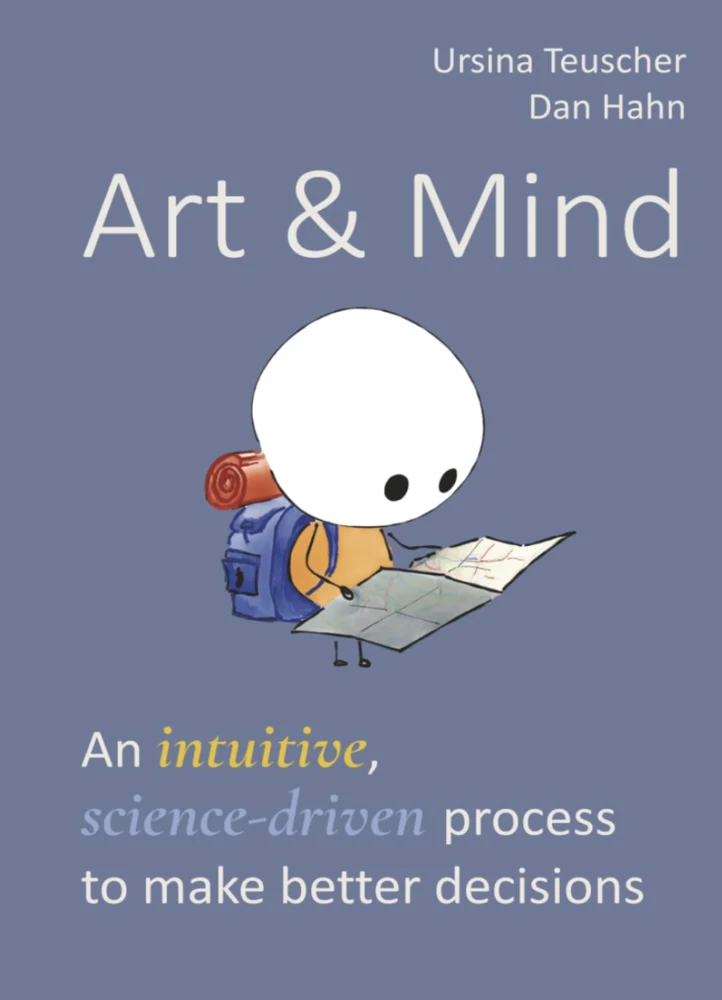
Art & Mind: An Intuitive, Science-Driven Process to Make Better DecisionsBy Ursina Teuscher and Dan Hahn
Open a sample in the reader
The free Chapter 2 lesson
Before your students choose, teach them to ask better questions.
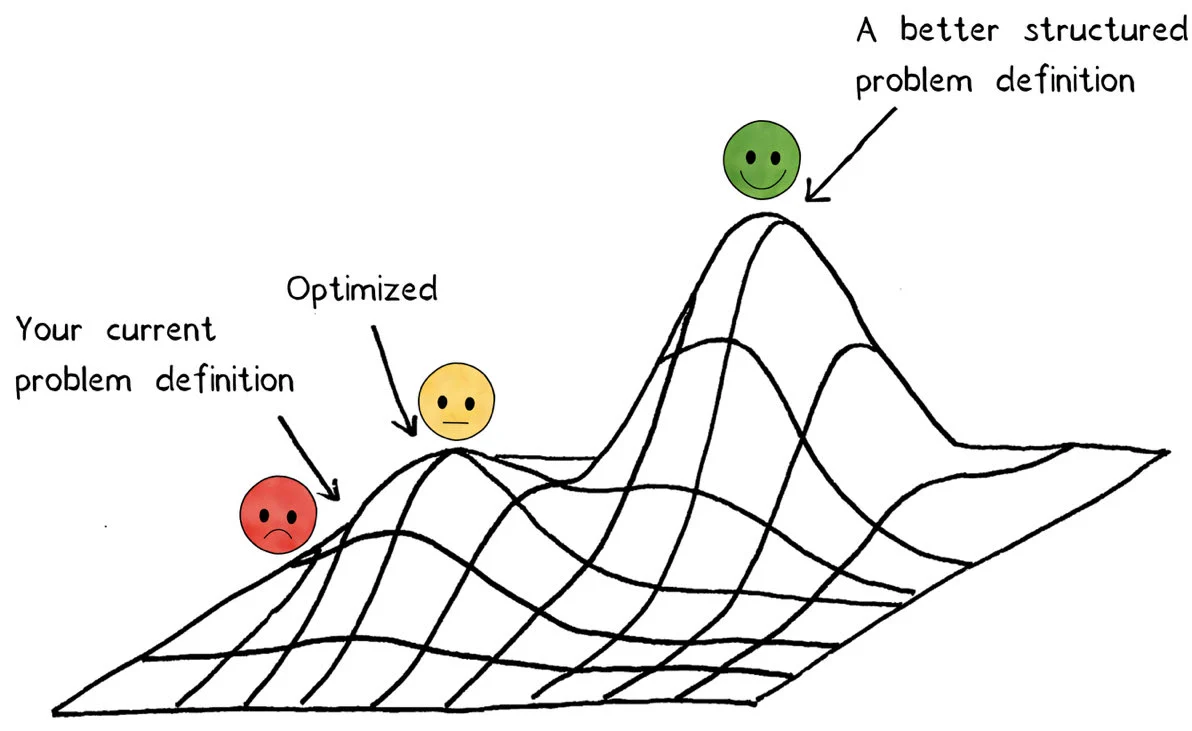
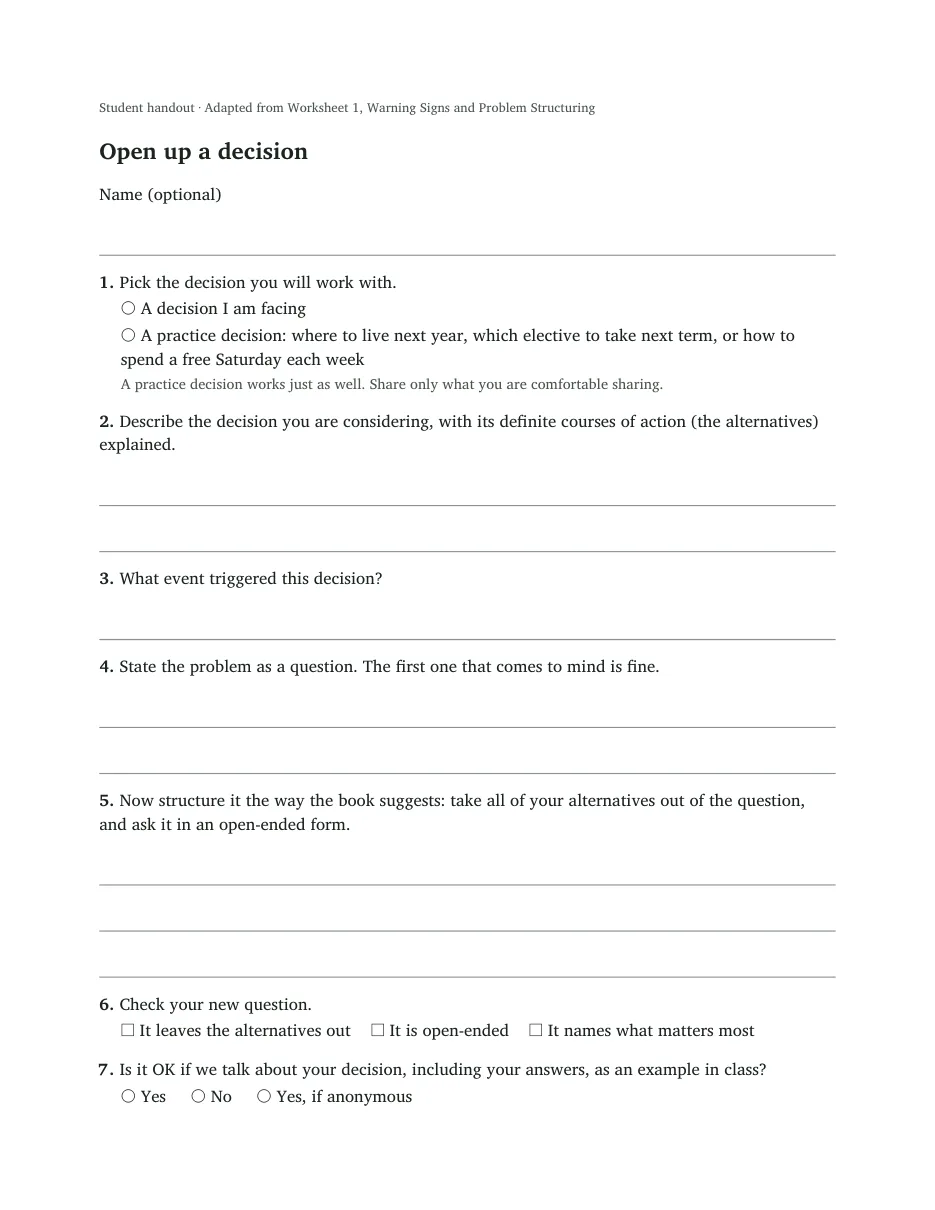
Tony’s first question, p. 66“Is Seattle or Dallas better for my finances and the relationship I have with my children?”
The same question, opened up, p. 67“What work arrangement is best for my finances and the relationship I have with my children?”
The solution landscape, Chapter 2, p. 68.Tony’s employer gave him two choices, Dallas or Seattle, and he weighed them for days. Chapter 2 teaches students to take the options out of their questions and ask what matters.
Tony’s first question, p. 66“Is Seattle or Dallas better for my finances and the relationship I have with my children?”
The same question, opened up, p. 67“What work arrangement is best for my finances and the relationship I have with my children?”
The teaching kit
You bring the teaching. We’ve done much of the preparation.
The Chapter 2 kit is four pages, free to download and use, built from the book’s own exercise bank and worksheets.
All of it is tried and tested in our own classes, both in person and as a fully asynchronous online course.
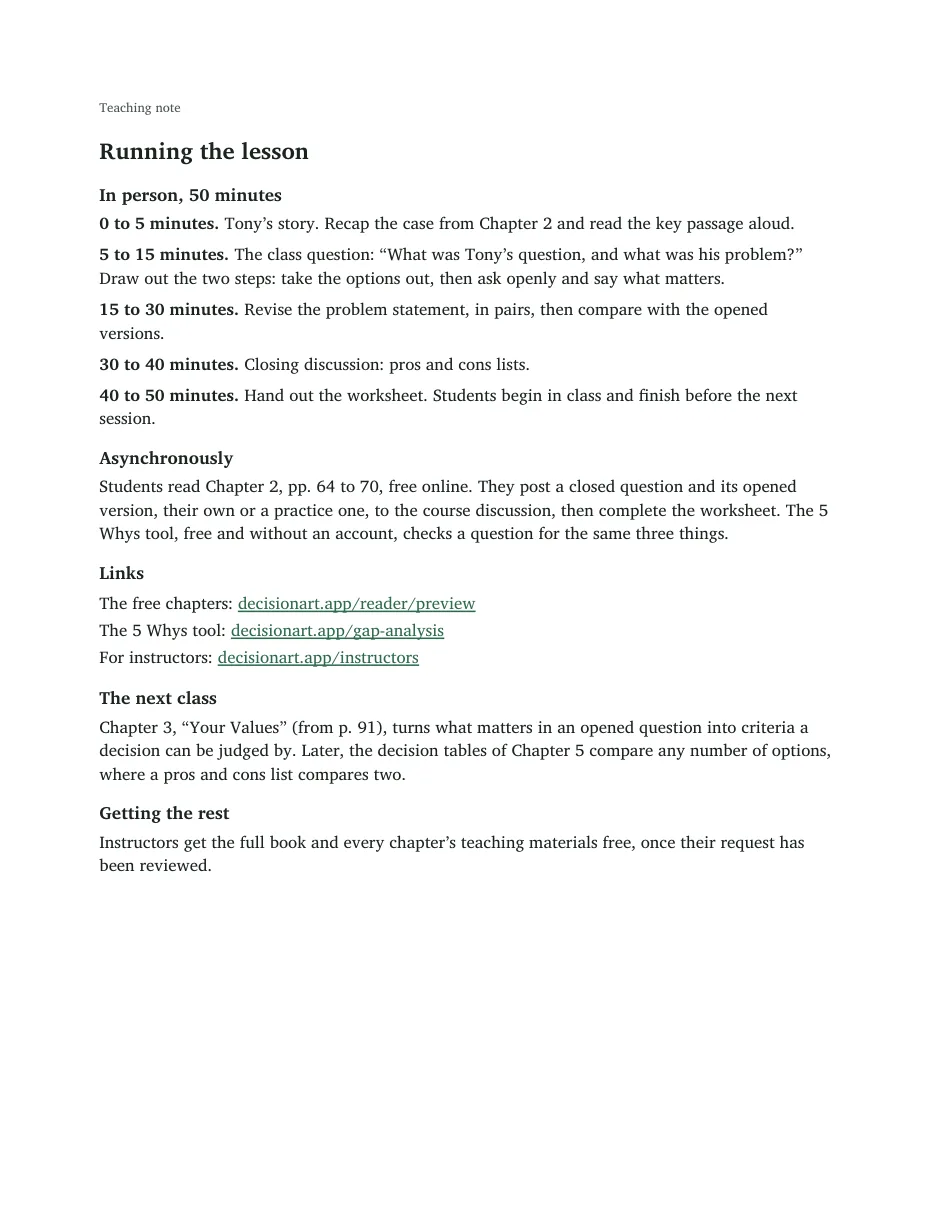
A teaching note, minute by minute 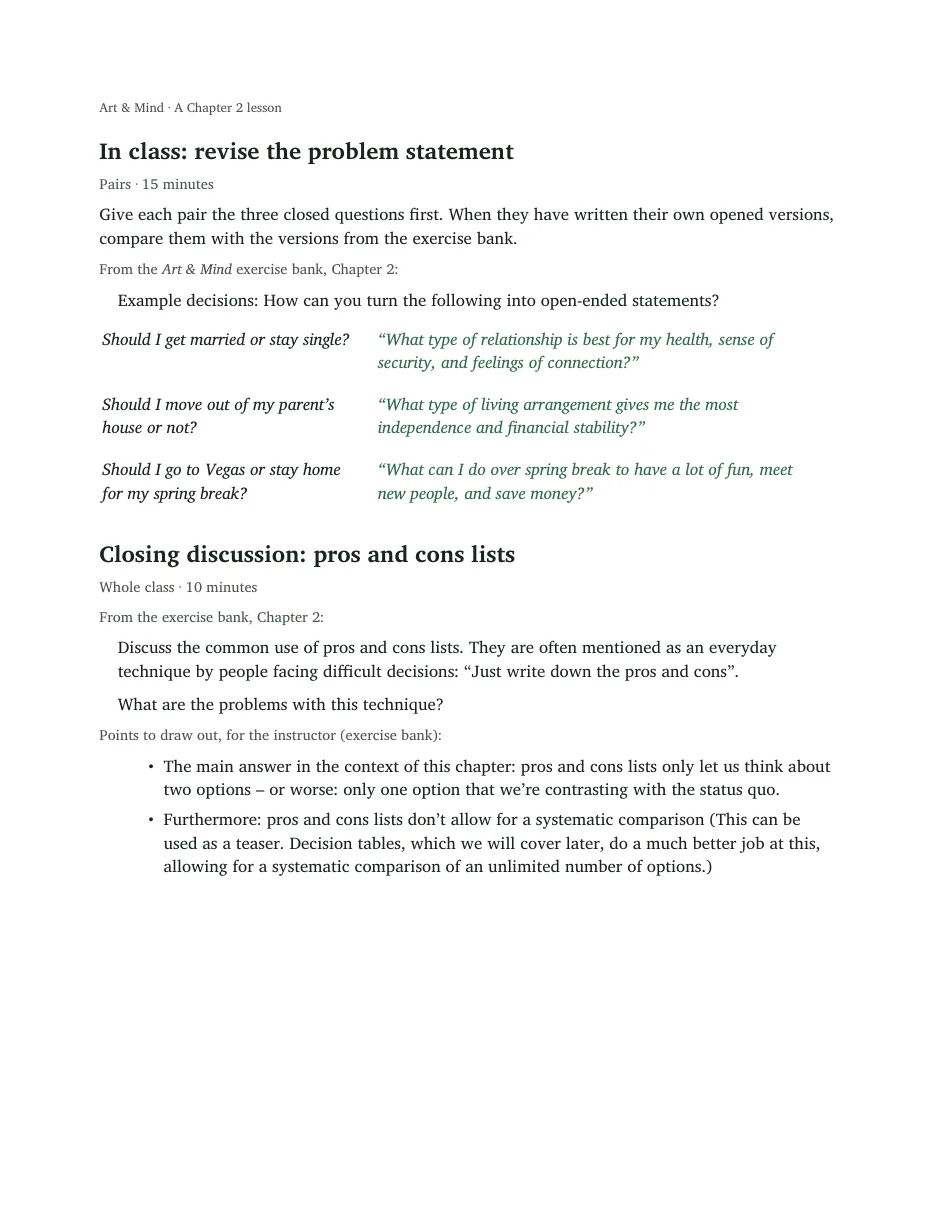
The pairs activity, with the exercise bank’s answers
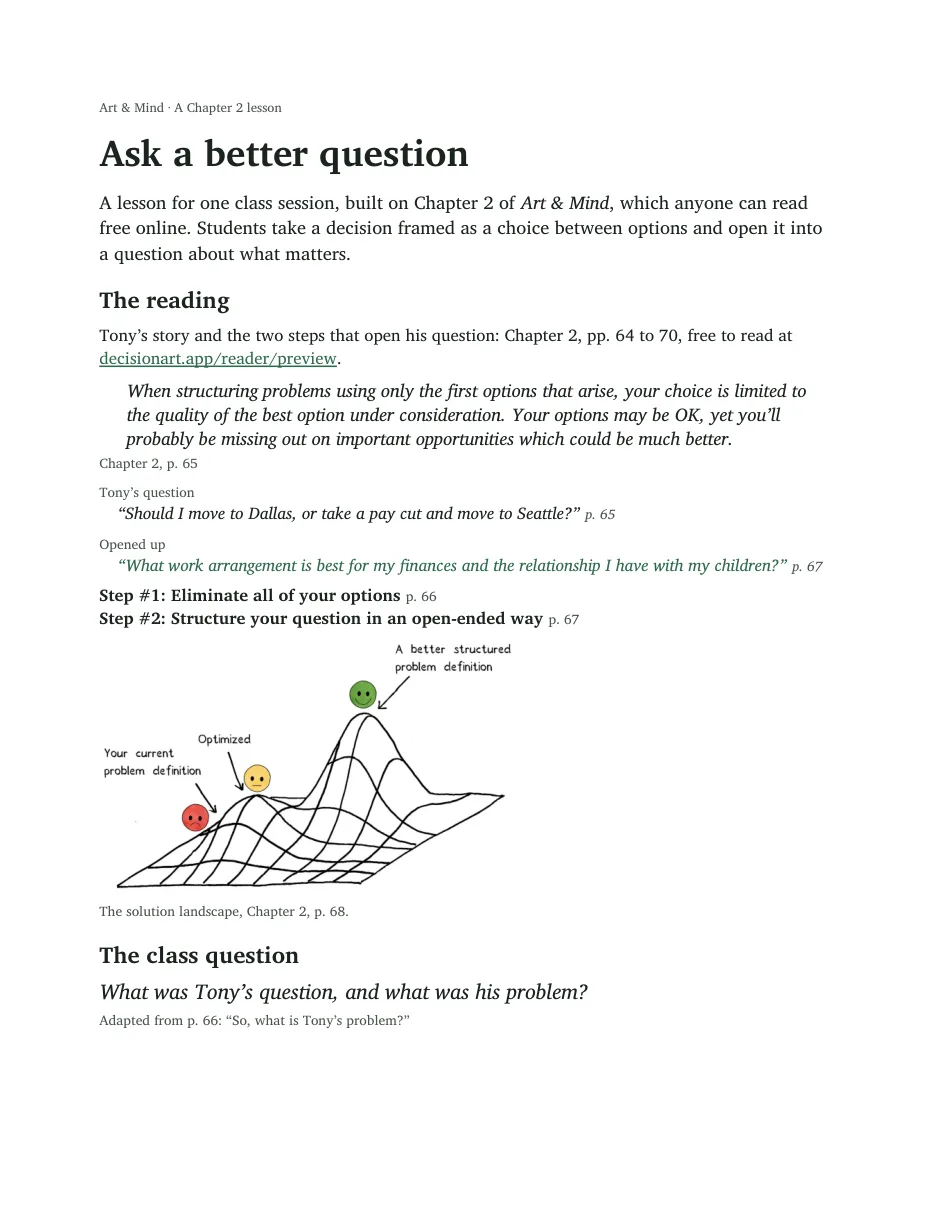
Slides for every chapter, as PDFs (other formats on request). Quizzes, classroom activities and curated videos for every chapter, six worksheets for Chapters 2 to 7, two short papers, a final paper and a group capstone.
Kits like this exist for every chapter. We share them with instructors who are considering the book: ask for instructor access or write to us.
Why this book
Research-based tools for the decisions students actually face.
Scholars have developed powerful decision tools, yet many remain difficult to teach, overly technical, or detached from the intuitive and emotional judgments that dominate everyday decisions. As a result, students are often left without guidance precisely where they struggle most: career choices, relationships, ethical tradeoffs, and balancing work and life. Art & Mind addresses this gap by integrating decades of decision research with structured intuitive checks.
The book fits courses in psychology, management, and interdisciplinary studies, including critical thinking, judgment and decision making, career and life planning, and first-year and upper-division seminars. At Portland State it is the text for Personal Decision Making (PSY 300U), and this fall an instructor at Chico State adopted it for his critical thinking course.
The course draws on Keeney, Raiffa, Kahneman and Gigerenzer, and the book closes with a full bibliography. No math at first; by Chapters 5 and 6, students work with weighted tables, sensitivity analysis, decision trees and expected value.
Written by people who have taught it
Ursina Teuscher and Dan Hahn met co-teaching Barry F. Anderson’s decision-making course at Portland State University. Barry, their mentor, was a professor of psychology there, and his teaching manual became their first textbook together, Heart and Mind (2013). Art & Mind is its successor, updated with new research and case studies. Ursina holds a Ph.D. in Applied Psychology, has taught decision-making since 2001, and painted every illustration in the book. Dan leads A Portland Career, a coaching practice devoted to helping people find fulfilling work.
The seven chapters
From better questions to sound decisions.
Each chapter pairs the research with worked cases and exercises, and builds toward a full decision analysis students carry out on a decision of their own. Every chapter has a quiz bank, Chapters 2 to 7 have worksheets, and Chapters 2 to 7 each come with a free interactive tool.
Chapter 1
Courage, Creativity, and Balance
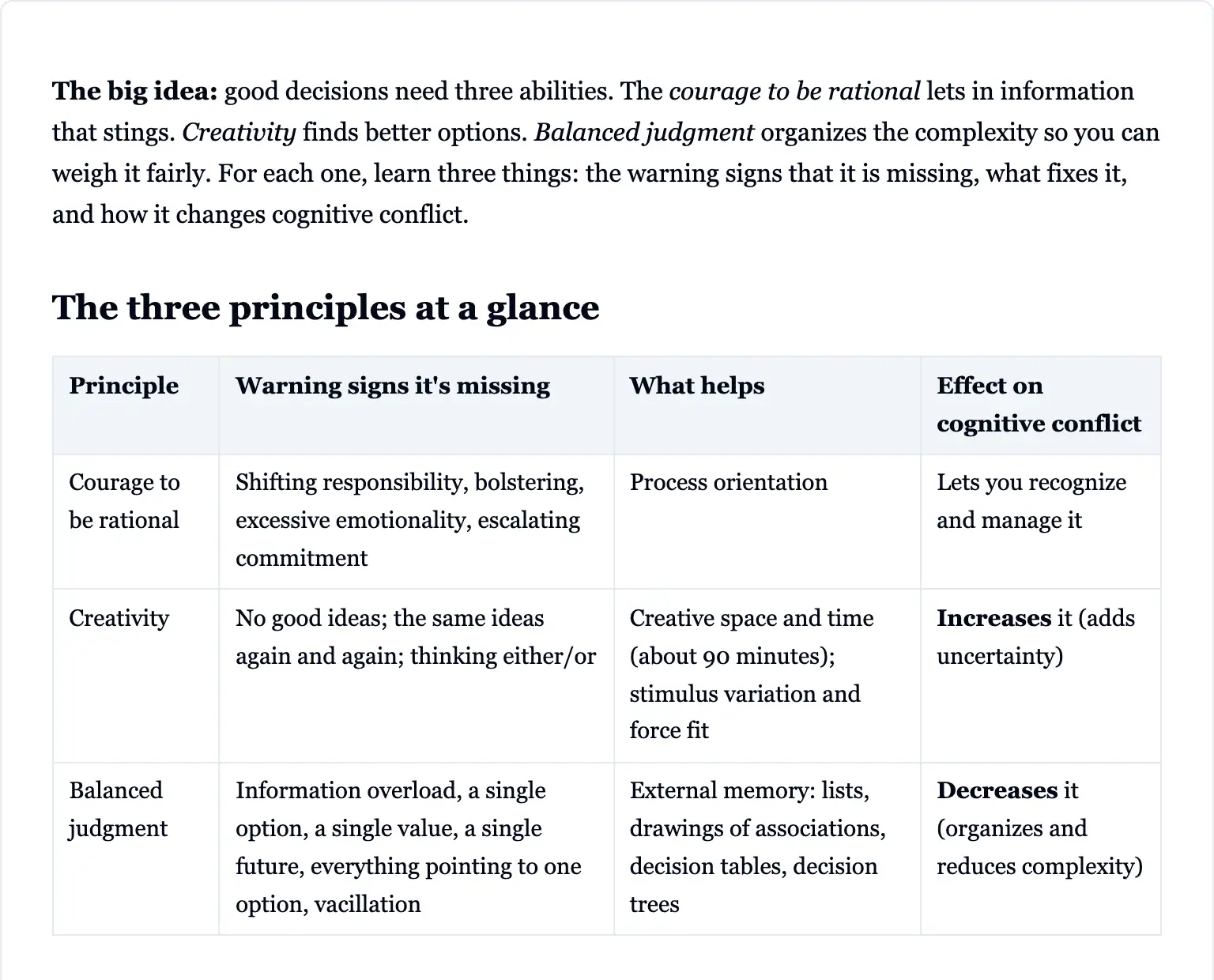
The conditions for good judgment: how cognitive conflict, the interplay of importance and uncertainty, shapes whether we avoid a decision, panic, or engage it; and the warning signs and correctives for failures of rationality, creativity and balanced judgment.
Key concepts: cognitive conflict, hot and cold decisions, working memory limits and external memory, sunk costs, process versus outcome.
Chapter 2
Problem Structuring
Why the way a problem is framed limits the solutions that can be found, and how to state it openly, in terms of the ends it serves rather than the options already in view.
Key concepts: open problem statements, problem scope, causal analysis, correlation and causation, the solution landscape. Tool: The 5 Whys.
Chapter 3
Your Values
Value-focused thinking after Keeney: identifying the values at stake, distinguishing fundamental values from means, and structuring them into a complete, non-redundant set fit for analysis.
Key concepts: value trees, fundamental and instrumental values, completeness tests, independence of values, ethical checklists. Tool: The Values Sorter.
Chapter 4
Generating Alternatives
The cognitive mechanisms that narrow the options we consider, and research-based techniques for widening them, individually and in groups.
Key concepts: stimulus variation, value-guided search, force fit, openness to experience, creativity techniques for groups. Tool: The Options Expander.
Chapter 5
The Decision Ladder
A graduated sequence of decision tables, from screening and plus-minus tables to weighted 1 to 10 tables, so that the depth of analysis matches what the decision warrants.
Key concepts: screening, dominance and relevance, weighting, extremes tables, resource allocation and portfolio effects. Tool: The Weighted Matrix.
Chapter 6
Uncertainty
Making choices that hold up when outcomes are uncertain: increasing awareness of uncertainty, reducing risk by keeping options open, and testing a choice formally.
Key concepts: sensitivity analysis, decision trees, expected value, the law of large numbers, regret. Tool: The Uncertainty Modeler.
Chapter 7
Moving Forward With Confidence
Integrating the process and committing to a choice: testing commitment across moods and cognitive states, after a custom Herodotus describes; recognizing that a close call between top options signals a well-structured decision rather than a failed one; and setting down the demand for a perfect choice. The chapter closes with an annotated guide to further reading in descriptive and prescriptive decision science.
Key concepts: commitment across cognitive and emotional states, close calls between well-matched options (Duke), releasing perfectionism (Burkeman), decision making as a practiced habit. Tool: The Persian Test.
The Introduction and Chapters 1 and 2 are free to read. Read them now
What your students will learn
- Identify and avoid common cognitive biases
- Clarify their values and the tradeoffs that matter
- Generate creative alternatives beyond the obvious two
- Compare options with weighted decision tables
- Test how robust a choice is with sensitivity analysis
- Map uncertain outcomes with decision trees and expected value
- Evaluate options realistically under uncertainty
- Anticipate and reduce decision regret
Inside the course
What students do with it.
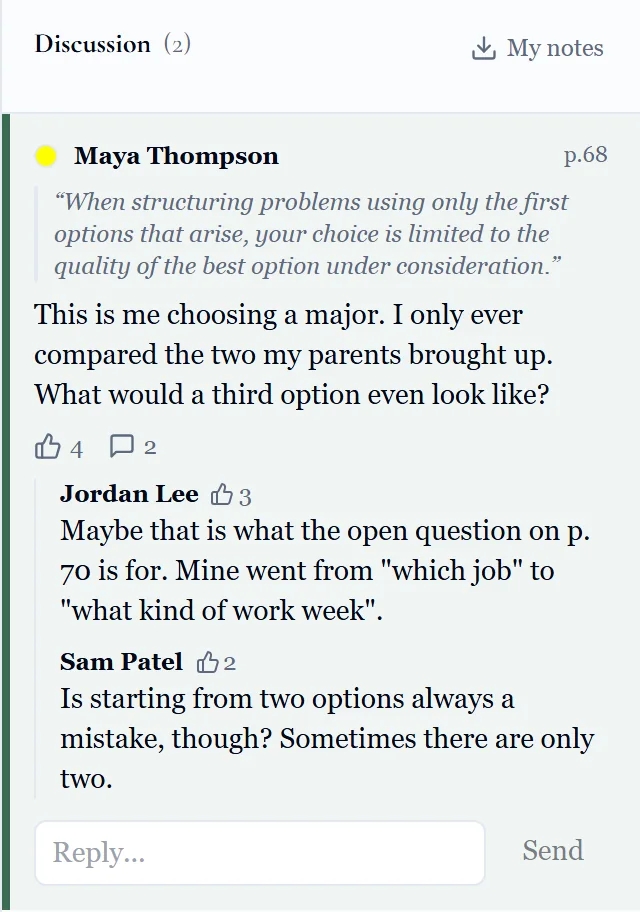
Reading becomes a conversation.
Students comment in the margin of the online book, and their small group answers.
A student asks
“What would a third option even look like?”
They also work through their own decisions in the toolkit (the 5 Whys, the Values Sorter, the Options Expander, the Weighted Matrix, the Uncertainty Modeler and the Persian Test), take quizzes from the book’s bank that score themselves, write, reflect aloud, respond to videos and podcasts, and hand in worksheets.
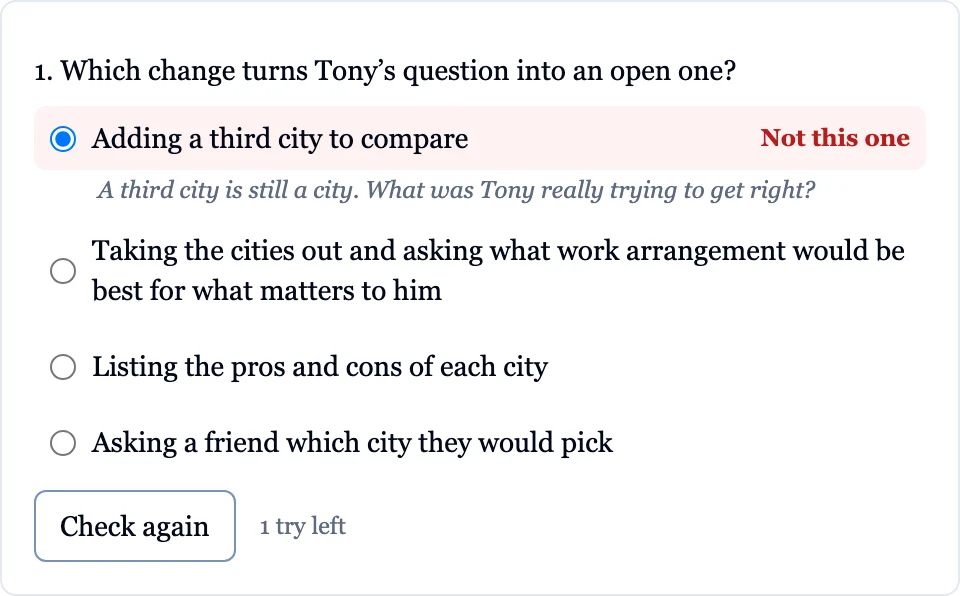
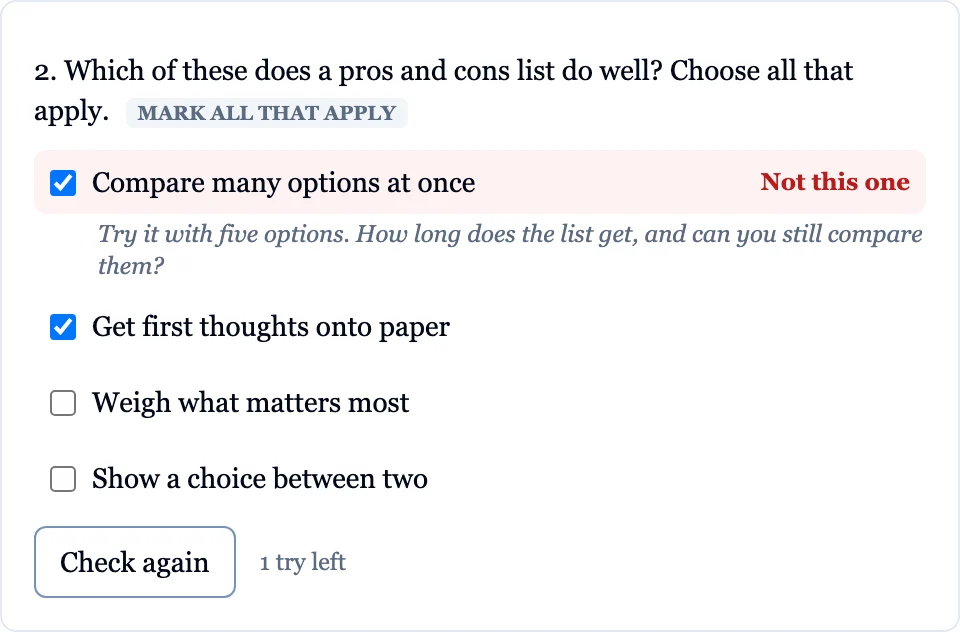
Quizzes that grade themselves
Use the book’s question bank for any chapter, or write your own.
The course platform
Made to save you time and keep you in charge.
What sets it apart
Scoring you stay in charge of
A reason with every score
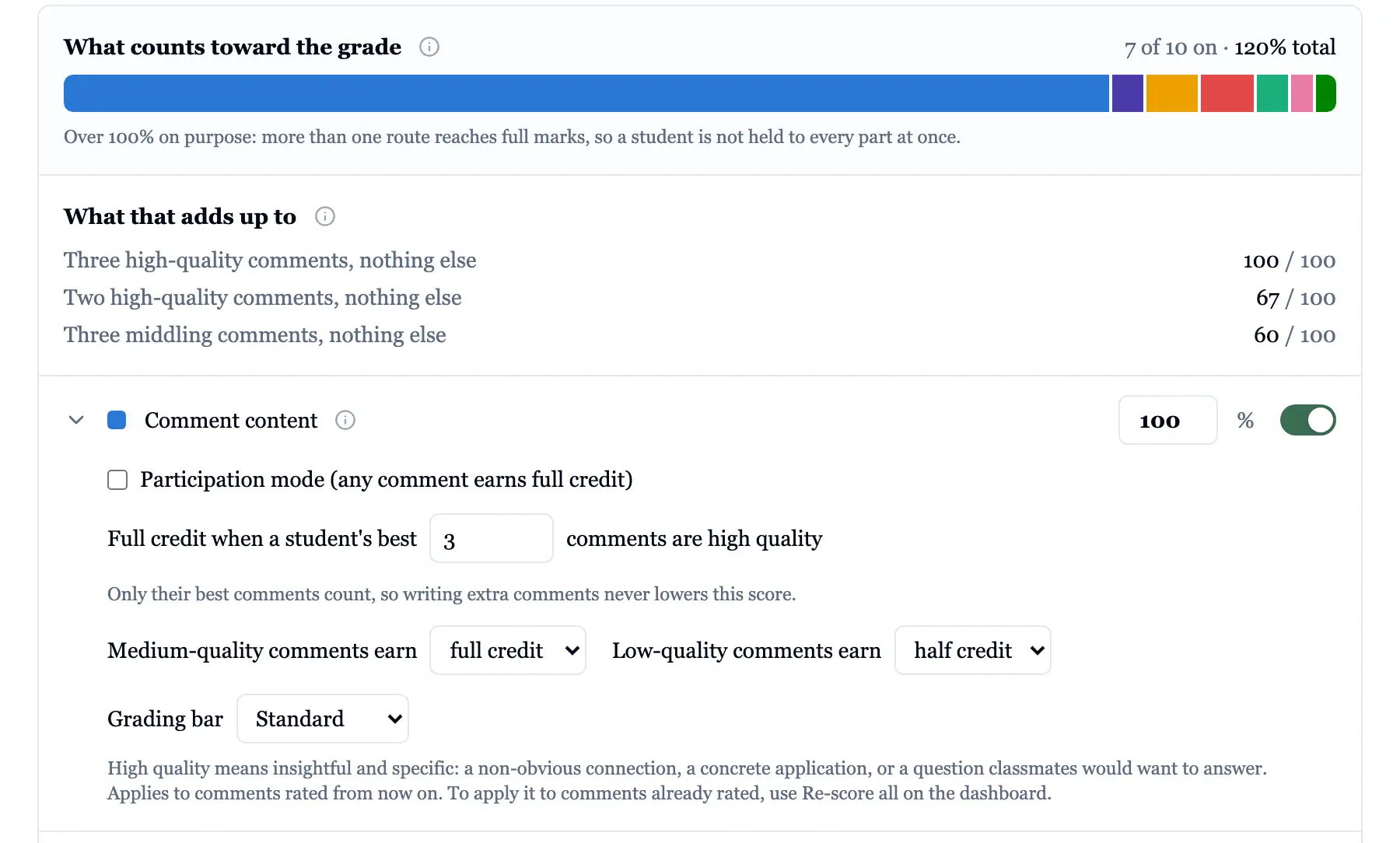
Each comment’s AI rating comes with a short note written to the student: what the comment does well and, below full marks, one way to take it further. You see it beside your override; students see it only if you choose.
Your standard, your final say
Set the grader to generous, standard or demanding, or turn rating off. Any score you change stays changed.
Pasting instead of writing is flagged
In written responses, you see how much of the text was pasted and can watch the writing play back. You decide what it means.
Every student can keep up
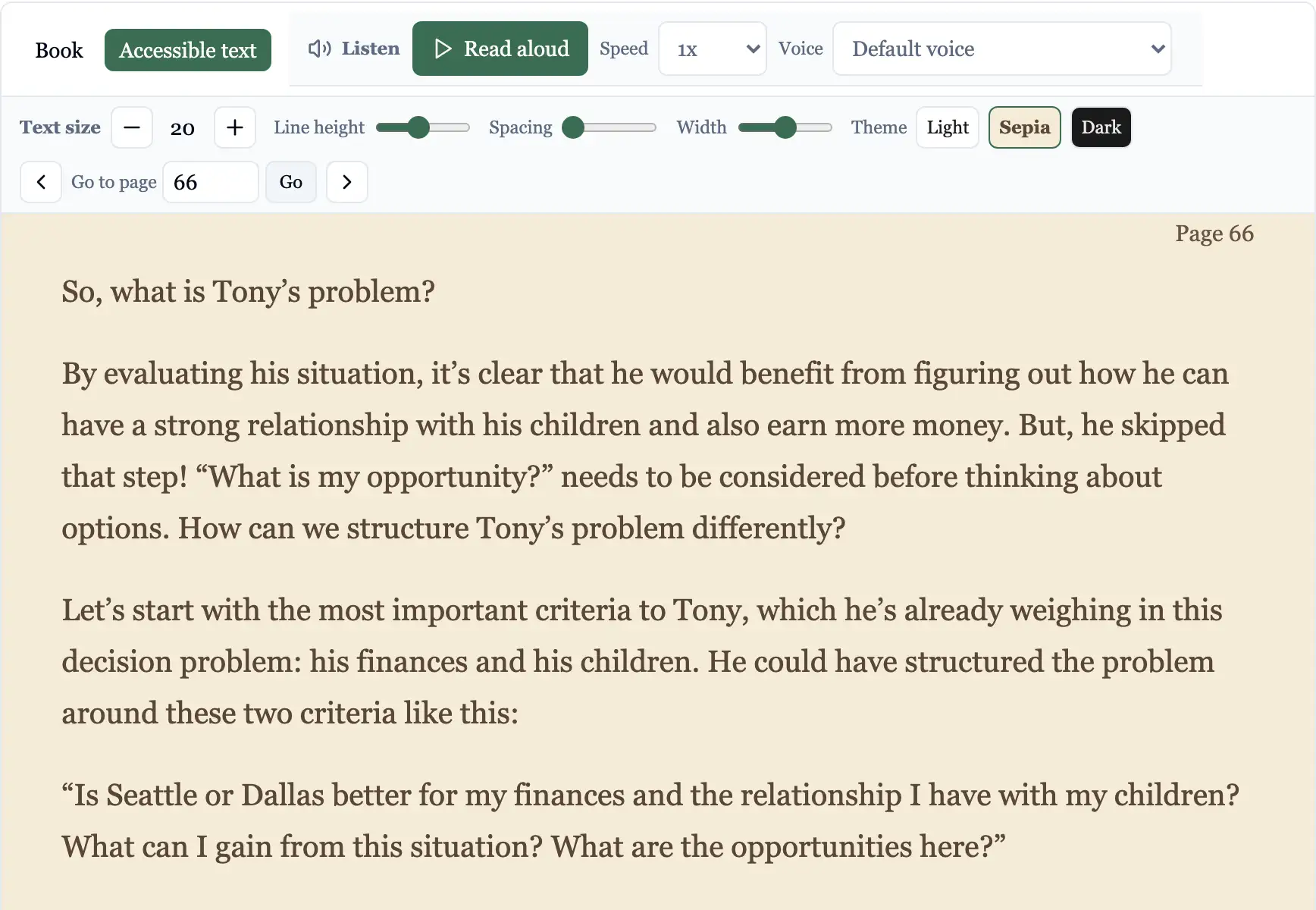
Accessible text for every reading
The book and your PDFs open as reflowable text with adjustable size, themes and read-aloud. Image descriptions are written by people, and at upload you learn what a student who cannot see the page would miss.
Extensions for accommodations are a breeze
Set a student’s extra time once, not once per assignment. It covers every assignment, including ones you add later, and late rules and the gradebook follow their date.
Prepare quickly, stay organized.
A new term in minutes
Copy last term’s course and every deadline moves with the first due date. Extensions live on the same page.

Built from what students asked for
Study help for every chapter
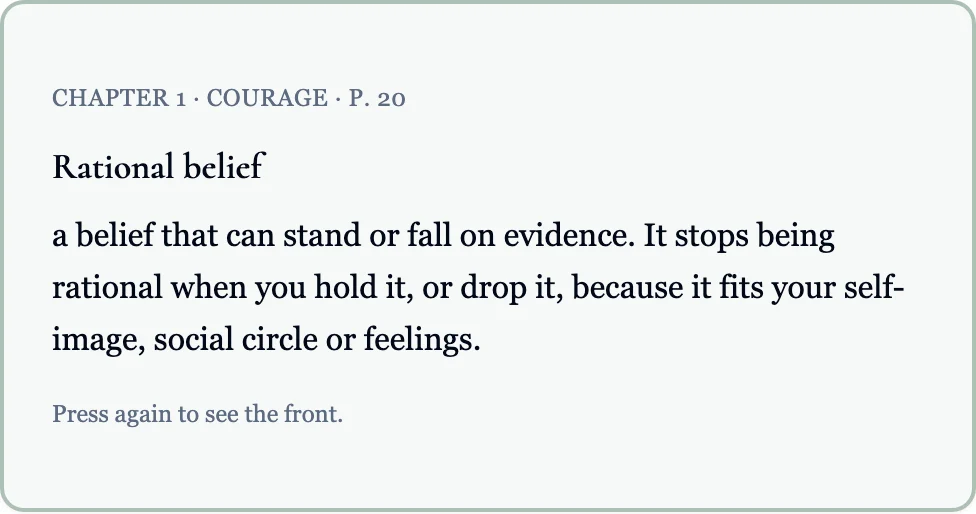
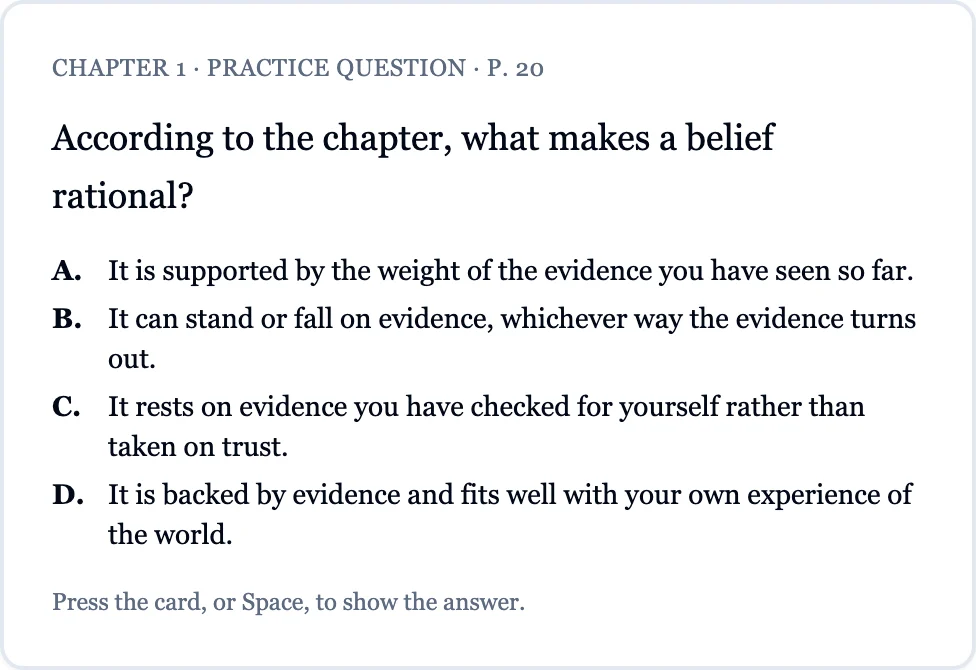
A study guide, flashcards and practice questions for every chapter come with the book, none of it graded. Students’ own comments also download as notes to keep after the term.
Explore the full teaching toolkit
Open any item for the details.
Students can
Discuss readingsHighlight, comment and reply in small groups
Highlight, comment and reply in small groups. Scored by rules you set for commenting, replying and reading. By default an AI model rates how thoughtful each comment is; participation mode turns that off, and you can change any score.
Work with decision toolsSix tools and one full decision, start to finish, on a decision of their own or a practice one
Six tools and one full decision, start to finish, on a decision of their own or a practice one. Full credit when submitted; you review it, adjust the score and release it.
Take quizzesFrom the book’s bank or written by you
From the book’s bank or written by you. They score themselves, and practice quizzes count only once you give them weight.
Write responsesToward a word count you set
Toward a word count you set. Credit when submitted; you read it, adjust the score and leave a comment.
Record spoken reflectionsA spoken answer to your prompt
A spoken answer to your prompt. Credit when submitted; you listen, adjust the score if needed and leave a comment.
Respond to videos and podcastsWatch or listen, then answer
Watch or listen, then answer. Credit when they mark it done and answer, and you can adjust it.
Submit worksheets and papersHand in a link
Hand in a link. Credit when it arrives, and you review and adjust it.
Instructors can
Copy a course to a new termDates move with the first due date
Dates move with the first due date. Choose whether readings, assignments and scoring come along; dates move when you enter the new first due date. The copy gets a join code of its own.
Set and extend due datesEvery date on one page
Every date on one page. Shift the whole schedule, build a term by pasting a schedule in, and extend for one student, a few, or the whole class, including a standing extension for accommodations.
Configure grading rulesWeights, presets, late and missing work
Weights, presets, late and missing work. Start from a preset, weigh comment quality (rated by AI unless you turn it off), replies, reading time and quizzes, drop the lowest scores, and save the setup to use again.
Build a quiz in one stepPick the chapters and the number of questions
Pick the chapters and the number of questions. Each student gets their own random draw, balanced across the chapters you pick, from questions kept for exams, so a test never repeats what students practiced. Hints and explanations come already written. The same bank also downloads for other learning platforms.
Inspect and adjust gradesSee how each score was built
See how each score was built. Adjust a score, add a comment or extend a deadline from the gradebook, and release grades when you are ready.
Preview the student experienceA test student in every course
A test student in every course. Open each page of your course the way your students will, and see a student’s scores as they see them.
Add readings and mediaPDFs, links, videos and podcasts
PDFs, links, videos and podcasts. Upload PDFs (students annotate them like the book) or add links, and add videos or podcasts, including a curated collection grouped by chapter.
Reuse question promptsA bank of prompts
A bank of prompts. Keep the questions you ask students in one library and reuse them across activities.
Explore students’ discussion questionsGrouped by topic, on request
Grouped by topic, on request. AI sorts the questions in recent comments by topic and shows the students’ own comments under each. You choose the time span or one assignment. Nothing is stored.
Monitor class engagementA dashboard, with a flag for anyone falling behind
A dashboard, with a flag for anyone falling behind. Each student’s reading time, comments and the replies their comments draw, at a glance.
Download recordsScores, engagement and class notes
Scores, engagement and class notes. The gradebook as a spreadsheet, the dashboard as a CSV file, and students’ notes as a study guide. Sending grades straight to Canvas is not available yet.
Hear when work arrivesAn email when a student submits
An email when a student submits. Turned on for each submitted activity you choose (not for reading discussions or quizzes).
Invite co-instructorsTeach the course together
Teach the course together. Colleagues you invite can run the course with you.
Find in-class activitiesBy chapter
By chapter. Browse the book’s activities, discussions and role plays, and copy them into your plans.
Ways to start
Start as small as you like.
Teach one lesson
Chapter 2 and the 5 Whys tool are free and open to anyone, with no sign-up.
Use the chapters you need
Pick the chapters and materials that fit your course. The platform is free either way.
Run the whole course
All seven chapters, with plans for a quarter or a semester.
We build your course with you
You’re a fellow instructor, and we want this to be easy for you. We sit down together and build your course.
For a recent adoption, that meant mapping the book onto the instructor’s exact term calendar: sixteen weekly modules, the book’s chapters where they fit, open slots for the instructor’s own material where they didn’t. We seeded a video library matched to their topics, talked through the weekly assignment sequence together, and adjusted the gradebook to how they wanted to weigh participation.
See what you would teach.
Instructor access is free. It opens the full online book, the teaching materials, and a course of your own with a test student who shows you what your students see.
What it costs
The platform is free, students buy the online book.
Free
The course platform and every decision tool, for you and your students.
$64.95
Per student, a one-time purchase of the whole online book, when bought on this site. Access does not expire.
Free
Instructor access, once your request has been reviewed.
Free
The Introduction and Chapters 1 and 2, for anyone.
Varies
The hardcover, sold separately on Amazon. It does not include the online book.
Buying for a class
Students in a class buy through their course page, which shows that course's price before checkout.
Every course can use the platform for free. Students buy the online book only when the course assigns Chapters 3 to 7.
Using a few chapters? Chapters 3 to 7 come with the whole online book; there is no per-chapter price. The Chapter 2 lesson needs no purchase at all.
Already teaching with Perusall? The book is available there too; mention it in your instructor access request.
For your department, accessibility office and bookstore
Short answers to questions we often get.
Price and formats
The course platform and its decision tools are free, and so are the Introduction and Chapters 1 and 2. Chapters 3 to 7 come with the whole online book, $64.95 per student, a one-time purchase directly on this site, with access that does not expire; students in a class buy through their course page, which shows that course's price before checkout. The hardcover is sold separately on Amazon and does not include the online book. Instructor access is free once a request has been reviewed. The book is also available on Perusall.
Canvas
The gradebook downloads as a spreadsheet for your own records. Sending grades straight to Canvas is not available yet, so for now they are entered in Canvas directly.
Accessibility
The book and the PDFs you upload switch to an Accessible Text mode with adjustable size, themes and read-aloud. The book’s image descriptions are reviewed by the author; for your uploads you write them, and at upload the app tells you what a student who cannot see the page would miss.
Our security questionnaire is available on request.
Privacy
How student data is collected and used is set out in the privacy policy.
Where AI is used
The book was written by its authors, and the decision tools guide students through each step but never send their answers to an AI. Inside your course, the platform uses AI, always Anthropic's models, in three places. It rates, by default, how thoughtful each comment on the reading is, to help score participation; you can change any score, and participation mode turns the rating off for your course, so no comment is sent, every comment counts the same, and students earn full credit once they leave the number of comments you set. If you turn it on for an activity, it suggests a grade and feedback on written, spoken and media work, which no student sees until you release it. And the question summary runs only when you press its button, and stores nothing.
Bookstore
Campus bookstores can sell access codes for the online book. Online edition ISBN 979-8-218-85170-5; hardcover ISBN 979-8-218-79993-9.